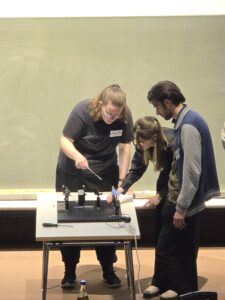
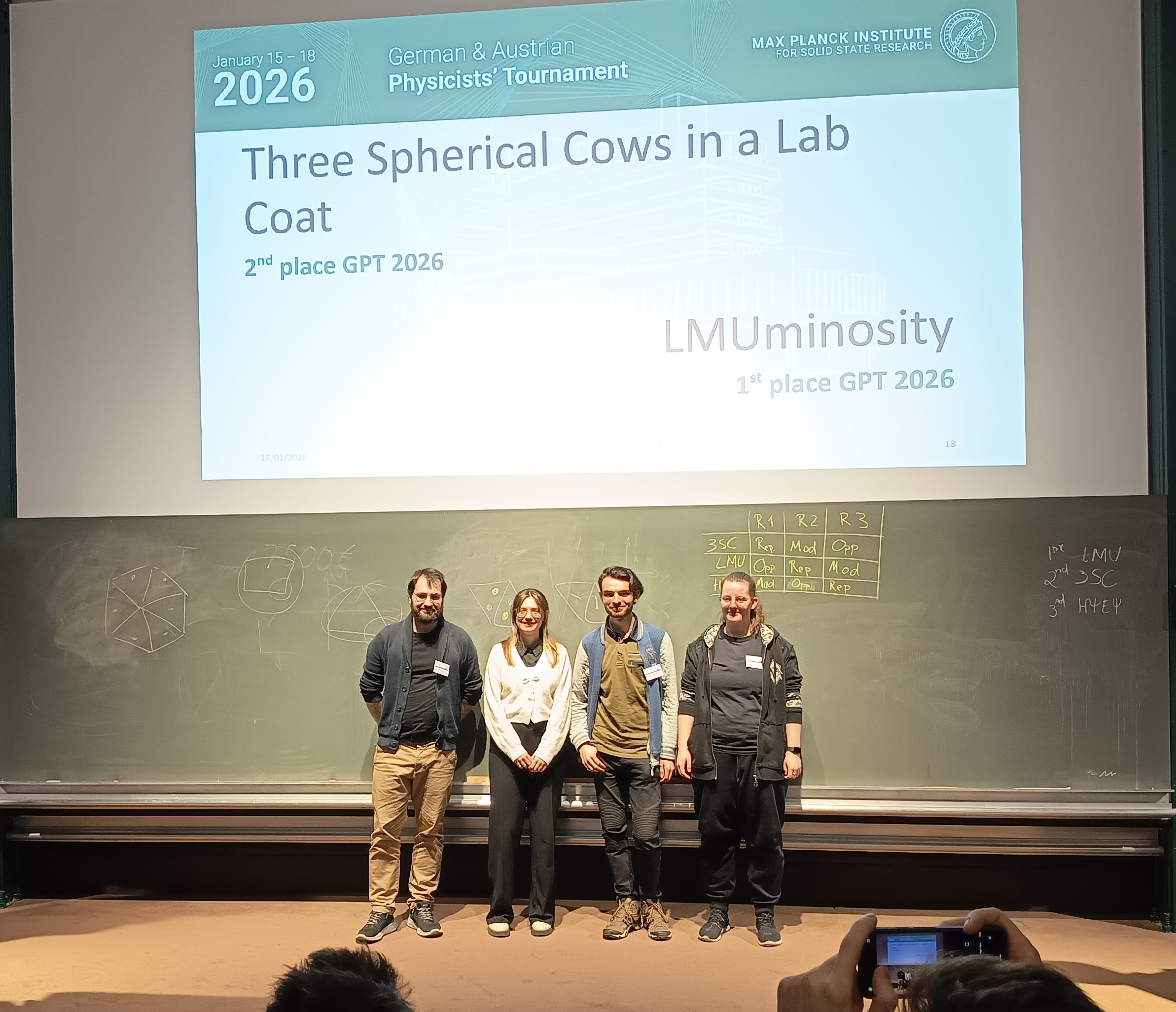
Team from Erlangen reaches the second place in the German Physicists‘ Tournament
How do you measure the remaining charge of a battery with non-invasive purely mechanical methods? What is the best way to stabilize beer foam? How can you actually build a Maxwell’s Demon in a two-dimensional macroscopic system? What are the analogs of the essential components of a laser in a water system?
The German Physicists‘ Tournament (GPT) is a competition where students have to work on open physics problems. At the tournament in each round one team presents their approach that then is criticized by another teams and has to be defended in a discussion.
The GPT 2026 took place from January 15th to January 18th at the Max-Planck-Institute for Solid State Research in Stuttgart. It was the largest and longest GPT of all times: Almost 50 participants in a record number of 9 teams presented and discussed their solutions. The teams came from Aachen, Berlin, Erlangen, Hamburg, Munich, Münster, and Potsdam. Furthermore, one of the teams was the national team of Austria such making it a combined Austrian and German Physicists‘ Tournament.
In the final, teams from Berlin, Erlangen, and Munich competed for the title that was won by the team from LMU Munich. Therefore, the team from Munich is directly qualified for the International Physicists‘ Tournament 2026 that will take place in the USA. The team from Erlangen with Sky Blumberg, David Hashemolhosseini, and Elena Meier became second. Furthermore, Sky Blumberg was awarded a prize as the best opponent.
Homepage of the Soft Matter Theory group: https://www.emergent.physics.nat.fau.de/soft-matter-theory/
Homepage of the GPT: https://germany.iptnet.info/